

Late Talker vs. Speech Delay: What’s the Difference?
A late talker is a toddler aged 18–30 months who understands language and interacts typically but speaks fewer words than expected. A clinical speech-language delay is broader, affecting understanding, use, or combining of words, and needs professional assessment.
If your child isn’t talking as much as other children their age, it’s natural to worry. Many parents hear “he’ll speak when he’s ready,” but waiting isn’t always the right answer. This guide explains how to tell the two apart, what to watch for, and when to seek an assessment.
What is a late talker?
A late talker is a young child with a small spoken vocabulary for their age, but who is otherwise developing typically. Late talkers generally:
- Understand what is said to them and follow simple instructions
- Use gestures, pointing, and eye contact to communicate
- Play imaginatively and show interest in other children
- Have no major concerns in hearing, movement, or social behaviour
Some late talkers catch up on their own, but not all do. Since it’s difficult to know at the outset which children will catch up, a professional check is the safest route.
What is a clinical speech-language delay?
A speech-language delay means a child is developing language more slowly than expected across one or more areas:
- Receptive language: understanding words, questions, and instructions
- Expressive language: using words, combining them, and forming sentences
- Speech clarity: producing sounds so others can understand
- Social communication: turn-taking, responding to their name, sharing attention
The key difference is that a late talker mainly has a limited number of spoken words, while a child with a speech delay often has difficulty understanding language too, or across several areas at once.
Language milestones to watch (general guide)
Children develop at different rates, so use these as a guide, not a diagnosis:
- By 12 months: babbles, responds to name, uses simple gestures like waving
- By 18 months: says several single words and points to show things
- By 24 months: uses roughly 50 words and starts combining two words (“more milk”)
- By 3 years: speaks in short sentences and is mostly understood by familiar listeners
Red flags: don’t wait and see
Book an assessment promptly if your child:
- Doesn’t babble or use gestures by 12 months
- Has no single words by 16–18 months
- Doesn’t combine two words by 24 months
- Doesn’t seem to understand simple instructions
- Loses words or skills they previously had
- Has limited eye contact or interest in interacting with others
Late speech can sometimes overlap with other developmental needs, such as hearing, sensory processing, attention, or social communication differences. This is why a structured assessment matters more than guessing from milestones alone.
How is a child’s language assessed at Krit Sankalp?
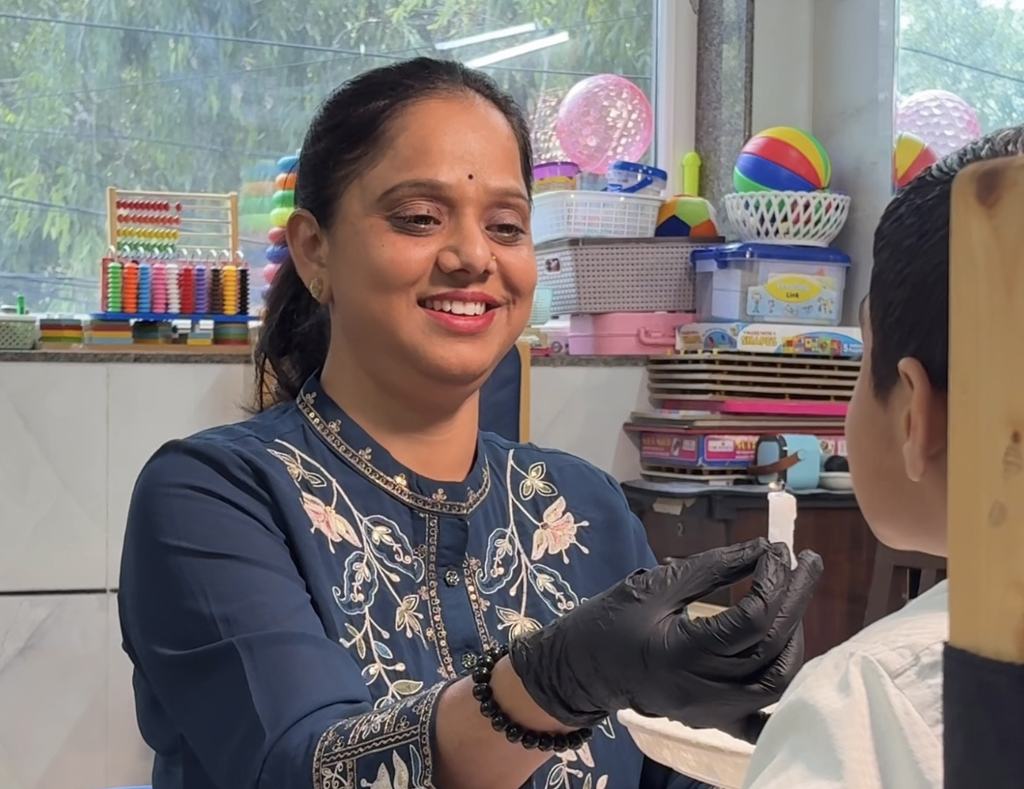
At Krit Sankalp, a first assessment is a calm, play-based 1-on-1 session. Where relevant, the therapy team uses structured tools such as the Receptive-Expressive Emergent Language Scale (REELS), which looks at both what a young child understands and what they can express, to estimate a child’s language level against expected milestones. Observations of play, attention, and social interaction are included, and parents are counselled on findings and next steps.
What can parents do at home?
- Narrate daily routines (“Now we’re washing your hands”)
- Give your child choices (“Apple or banana?”) and wait for a response
- Read picture books and name what you see
- Expand on their words (“Ball” → “Big red ball”)
- Limit passive screen time and prioritise face-to-face talk
These support language growth but don’t replace a professional assessment when red flags are present.
Frequently asked questions
At what age should I worry about a late talker?
If your child has no single words by 16–18 months, or isn’t combining words by 24 months, request an assessment. Concerns about understanding, gestures, or lost skills warrant a check at any age.
Can a late talker catch up without therapy?
Some do, but others don’t, and it’s hard to tell which at the outset. An assessment shows whether monitoring is enough or support would help.
Is a speech delay a sign of autism or ADHD?
Not necessarily. Many children with speech delays have neither. However, social communication, attention, and sensory differences can overlap with language delay, which is why a comprehensive assessment looks at the whole child.
Why choose 1-on-1 therapy for a young child?
Individual sessions allow the therapist to set the pace, reduce distractions, and tailor activities to your child, while coaching parents directly on what to practise at home.
Do you see families from outside Paschim Vihar?
Yes. Families from Punjabi Bagh, Vikaspuri, Janakpuri, Rajouri Garden, Rohini, Pitampura, and other parts of Delhi-NCR visit the center.
Book a developmental assessment
If you’re unsure whether your child is a late talker or needs support, an early assessment gives clarity. Contact us to book a 1-on-1 session.
Krit Sankalp Child Development Center
Guru White House, G 61, Block G, Pushkar Enclave, Paschim Vihar, New Delhi, 110063
📞 +91 88022 35413 | 🕐 10:00 AM to 7:00 PM
Easily reached from Punjabi Bagh, Vikaspuri, Rajouri Garden, Rohini, and Pitampura. Peeragarhi Metro Station
Disclaimer: This article is for general information and is not a diagnosis. Please consult a qualified speech-language professional for advice about your child.